The Ritual Is Thwarted in the Temple Chamber and Mal’akh Dies
The Lost SymbolThe ritual in the Temple Room of the House of the Temple is the climax of Mal’akh’s effort to turn his own death into a passage to supernatural power. He prepares to offer his body as a sacrifice and coerces Peter Solomon into acting as the instrument of that offering. Peter raises the Akedah Knife, but does not kill him; instead, a helicopter’s arrival shatters the room’s skylight, and falling glass fatally wounds Mal’akh. The reversal is both practical and symbolic: the ceremony ends not in transcendence, but in the death of the man who believed he had mastered its meaning.
The Ritual and Its Intended Sacrifice
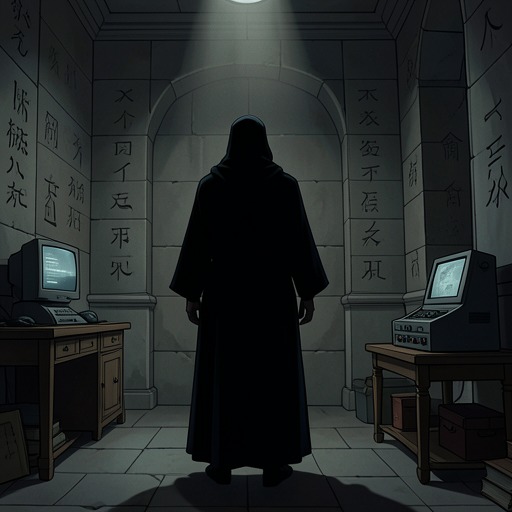
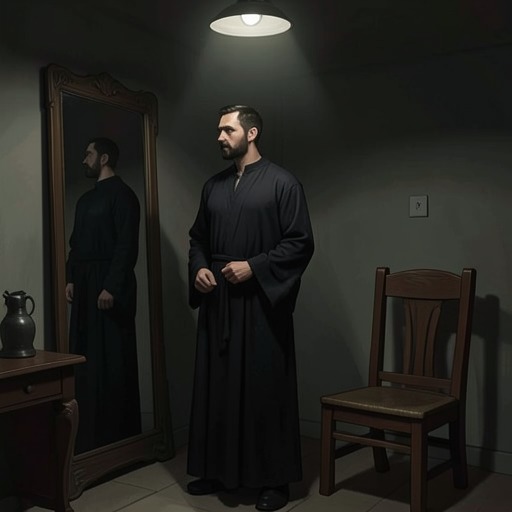
Mal’akh begins the ceremony in the chamber at the top of the House of the Temple, before its great altar. He has prepared his body over years, treating it as an artifact marked by ritual and inscribed symbols. Now, with Peter captive and watching, Mal’akh uses a crow’s-feather nib and Peter’s blood to write the Lost Word within the circular design on his scalp. He regards this act as the final preparation for apotheosis: in his understanding, receiving the Word makes a person ready for extraordinary power. The ritual is therefore not simply an attempt to kill Peter or escape captivity. Mal’akh believes that his own body, deliberately offered, is the essential gift.
The sacred setting reinforces his certainty. Incense rises above the altar, and moonlight enters through the chamber’s opening overhead. Mal’akh interprets the smoke and light as a route for a soul to leave the body. He imagines the ceremony as a passage beyond ordinary human limits, while the physical room remains the site of Peter’s captivity and a real, imminent threat. That tension between an imagined spiritual ascent and the material danger in the chamber governs the scene: Mal’akh treats the symbols as guarantees, but his plan depends on Peter making a choice under pressure.
Mal’akh presents the Akedah Knife as an artifact made for human sacrifice. He connects it to the biblical account of Abraham and Isaac and to the place of the Akedah in Freemasonry’s ritual tradition. For him, the knife’s history is not merely a matter of provenance: he believes its intended use has been withheld, and that he can fulfill that purpose now. After cutting the ropes that bind Peter to his wheelchair, Mal’akh places the knife in Peter’s left hand. The arrangement is meant to make Peter both the agent of the sacrifice and its unwilling witness, while Mal’akh casts himself as the offering.
Peter’s Impossible Choice
Mal’akh’s coercion draws on more than Peter’s physical captivity. He invokes the danger to Katherine and the threatened release of a file, presenting Peter’s compliance as the only way to protect his sister and his Masonic brotherhood. He also blames Peter for the past decision to leave Zachary in prison, turning their family history into another weapon. The accusation makes the ceremony an attempted punishment as well as a ritual: Mal’akh wants Peter to act while believing that every possible choice will bring further loss.
Peter knows the knife’s significance and understands that Mal’akh expects him to use it. He rises from his wheelchair, approaches the altar, and grips the weapon while Mal’akh lies down on the prepared shroud. From Mal’akh’s point of view, the scene appears to confirm the ceremony’s design: the son’s hand is to deliver the fatal blow, and the father is to release him from his body. Yet Peter’s presence at the altar does not amount to consent. His distress makes the decision visible as a conflict between the threats before him and his refusal to accept Mal’akh’s account of what sacrifice requires.
The Interrupted Climax
Robert Langdon and Turner Simkins reach the Temple Room’s doors after hearing Peter’s anguished cry. Langdon opens them and sees the black-robed figure at the altar, the blade raised over the person lying there. He rushes toward the scene, believing Peter is in danger. At that instant, the helicopter above the chamber sends its searchlight through the skylight. The transmitted file reaches completion, a separate consequence that Mal’akh’s threats had made part of Peter’s dilemma.
The helicopter’s attempt to hold position strains the glass roof. Its pilot tries to lift away, but a landing strut strikes the skylight, which breaks and sends shards into the chamber. The sudden arrival of the helicopter and the collapse of the roof interrupt the ceremony through physical forces Mal’akh has not incorporated into his design. He had interpreted the light above the altar as confirmation that his transformation was succeeding; the breaking glass turns that apparent sign of deliverance into the cause of his mortal injury.
Langdon collides with the black-robed figure and discovers that he has tackled Peter, not Mal’akh. Peter has not plunged the knife into the man on the altar. The Akedah Knife lies broken against the stone, and Peter has refused to spill Mal’akh’s blood despite the pressure and the threats against his family. The distinction is decisive: Mal’akh’s intended sacrifice depends on Peter’s action, but Peter does not complete the act. The ritual fails at the point where Mal’akh had made another person’s violence the instrument of his supposed self-transformation.
Mal’akh’s Death and the Aftermath
Mal’akh is left on the altar, unable to see and in severe pain as the helicopter leaves. The chamber’s imagery has changed meaning: the light and open roof no longer promise the ascent he anticipated, and the shattered glass marks the failure of his plan. He had believed that writing the Lost Word on his body and surrendering his flesh would bring him a divine reception. Instead, his own body is fatally damaged, and he is alone on the altar. Katherine’s survival further contradicts his assumptions; after the crisis, Langdon reassures Peter that she is safe.
When Katherine enters the brightly lit Temple Room, she sees Mal’akh’s body on the altar and the opening in the ceiling. She finds Peter being tended to by a medic, his right arm in a sling and his hand absent. Their reunion shifts the scene from the spectacle Mal’akh designed to the bond he could not break. Katherine embraces her brother, acknowledges his injury, and tells him that what matters is that he is alive and that she is safe. Peter, who has been the family’s protective figure, trembles in her arms; she comforts him in turn. The aftermath thus locates the lasting consequence not in Mal’akh’s imagined apotheosis but in the survivors’ grief, relief, and renewed care for one another.